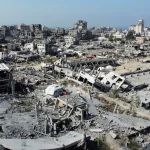
Mariam Dagga Gaza journalist became a symbol of courage when her last photos revealed a damaged stairwell outside Nasser Hospital in Khan Younis. Moments later, an Israeli strike killed her and 21 others, including five reporters. The images recovered from her camera showed people climbing the broken stairs and gazing from hospital windows after the first explosion.
Health officials confirmed that Israeli forces struck the hospital twice in quick succession. The military claimed it targeted a Hamas surveillance camera but offered no proof. Witnesses insisted no such equipment existed, and Hamas denied operating from the facility. The first missile killed a Reuters cameraman broadcasting live and another person nearby. The second blast claimed Dagga’s life.
Dagga, 33, often based herself at Nasser Hospital during the war. She freelanced for the Associated Press and documented Palestinians’ suffering with compassion. Her photos told the stories of displaced families and doctors struggling to treat children weakened by injuries or hunger. Her camera became her only weapon against violence and destruction.
The tragedy reached the United Nations. Algeria’s ambassador, Amar Bendjama, held up Dagga’s portrait at the Security Council on Wednesday. His voice trembled as he read from a letter she wrote to her son, Ghaith, before her death. The boy, only 13, left Gaza early in the war to live with his father in the United Arab Emirates.
In her letter, Dagga begged her son not to mourn but to remember her with prayer. “When I die, I want you to pray for me, not to cry for me,” she wrote. She urged him never to forget her love and asked that if he one day had a daughter, he name her Mariam in her memory. Bendjama described her as “a young and beautiful mother” whose courage lay in her work, not in arms.
International reaction highlighted the dangers faced by reporters in Gaza. The Committee to Protect Journalists condemned the killings and renewed calls for accountability. According to watchdogs, dozens of Palestinian reporters have died covering the conflict, making this war one of the deadliest for media workers in modern history.
The death of Mariam Dagga Gaza journalist underscored the human cost of the ongoing war. Her photographs captured a moment of survival amid ruins, and her final letter spoke of love and legacy. For many, her story illustrates both the resilience of Palestinian journalists and the devastating risks they face.
READ: WhatsApp Reveals Israeli Spyware Targeted Journalists and Activists