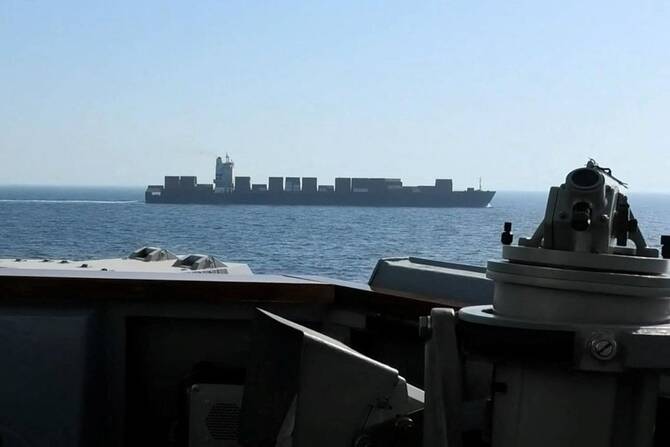
Pakistan moved ahead Monday with preparations for a new round of talks between the United States and Iran. These talks come just days before a tenuous ceasefire is set to expire. However, renewed conflict around the Strait of Hormuz has raised questions about whether the meeting will take place. Over the weekend, the US attacked and seized an Iranian-flagged cargo vessel that it said had tried to evade its blockade of Iranian ports. Consequently, Iran US talks doubts have emerged as both sides trade accusations.
Iran’s joint military command vowed to respond to the seizure. Foreign Minister Abbas Araqchi told his Pakistani counterpart that American threats to Iranian ships and ports were “clear signs” of Washington’s disingenuousness ahead of the planned talks, Iran state media reported. US President Donald Trump told Pakistan’s army chief Asim Munir that he would consider Munir’s advice on the Strait of Hormuz blockade being a hurdle to peace talks with Iran. A Pakistani security source shared this detail on Monday.
Pakistan Pushes for Talks Amid Iran US Talks Doubts
With tensions flaring and the ceasefire due to expire midweek, Pakistan has intensified diplomatic contacts with both Washington and Tehran over the past 24 hours. The goal is to resume the talks on Tuesday as planned, according to two Pakistani officials involved in the preparations. They spoke on condition of anonymity because they were not authorized to speak to the press. Trump has said American negotiators would head to the Pakistani capital on Monday, but it was not immediately clear whether those plans would now change.
Iran’s Foreign Ministry spokesperson Esmail Baghaei told reporters in Tehran on Monday that there were no plans yet to attend the talks with the US. However, he did not rule out attendance entirely. “We have no plans for the next round of negotiations and no decision has been made in this regard,” Baghaei said. Iran on Saturday said it had received new proposals from the United States but suggested a wide gap remained between the sides. Therefore, Iran US talks doubts center on whether either side has shifted its stances.
The unresolved issues include Iran’s nuclear enrichment program, its regional proxies, and the status of the Strait of Hormuz. Iran throttled traffic through the strait shortly after the US and Israel attacked Iran on Feb. 28 to start the war. The US has also instituted a blockade of Iranian ports. Roughly one-fifth of the world’s oil trade normally passes through the strait. Critical supplies of fertilizer for farmers, natural gas, and humanitarian supplies for places like Afghanistan and Sudan also transit this waterway.
Casualties Mount as Iran US Talks Doubts Persist
Since the war started, at least 3,375 people have been killed in Iran, according to a new toll released Monday. Abbas Masjedi, the head of Iran’s Legal Medicine Organization, provided these figures. He did not break down casualties among civilians and security forces but said 2,875 were male and 496 were female. Masjedi added that 383 of the dead were children aged 18 and under. More than 2,290 people have also been killed in Lebanon, 23 in Israel, and more than a dozen in Gulf Arab states. Fifteen Israeli soldiers in Lebanon and 13 US service members throughout the region have died.
Oil prices recovered slightly after Iran announced the strait’s reopening and a 10-day truce between Israel and Hezbollah took hold on Friday. However, Trump then said the US blockade “will remain in full force” until Tehran reaches a deal with the US. On Sunday, the military seized the Iranian cargo ship, the first interception since the blockade began last week. Iran’s joint military command called the armed boarding an act of piracy and a ceasefire violation. The state broadcaster reported that Iran vowed to again enforce restrictions imposed early in the war.
Oil Prices
Oil prices were up again in early trading on Monday. Brent crude, the international standard, traded at about $95 a barrel. That represents an increase of more than 30 percent from the day the war started. Iran early Monday warned it could keep up the global economic pain as ships remained unable to transit the strait. Hundreds of vessels are waiting at each end for clearance. The security of the strait is not free, said Mohammad Reza Aref, first vice president of Iran. “The choice is clear: either a free oil market for all, or the risk of significant costs for everyone,” he wrote on social media. He called for a lasting end to military and economic pressure on Tehran. The coming days will determine whether Iran US talks doubts lead to a breakdown or a breakthrough.