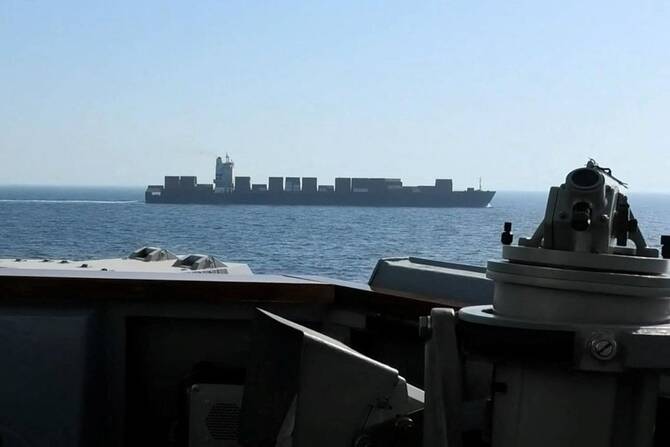
The Israel-Hamas war, which erupted in October 2023, has given rise to a new flashpoint in the Middle East: Houthi rebels disrupting global trade with missile and drone strikes in the Red Sea. Backed by Iran, the Houthis have hijacked ships, killed sailors, and forced major shipping companies to reroute around Africa — causing economic and security concerns that have drawn sharp responses from the U.S. and its allies.
Why Are the Houthis Attacking Red Sea Ships?
Originally, the Houthis claimed their missile and drone attacks were in solidarity with Palestinians, targeting vessels linked to Israel. But many of the affected ships have had no direct ties to Israel. Since November 2023, the group has sunk two ships, seized another, and killed multiple crew members. In response, the U.S. and U.K. have launched multiple airstrikes on Houthi targets in Yemen.
After the U.S. and U.K. began retaliatory strikes in early 2024, the Houthis expanded their target list to include American and British vessels — prompting fears of a wider regional escalation.
Why Is the U.S. Bombing Yemen?
The Biden administration initiated airstrikes in January 2024 to protect commercial shipping lanes and enforce freedom of navigation. However, the Trump administration, which returned to power in 2025, intensified the campaign in March after leaks exposed internal discussions about military action.
President Trump declared that “Iran-funded Houthi thugs” had endangered U.S. forces and trade routes, warning Tehran that it would be held “fully accountable.” The Pentagon emphasized a return to a “peace through strength” policy to deter further aggression.
Who Are the Houthis?
The Houthis, officially known as Ansar Allah, are a militant political group rooted in Yemen’s Zaidi Shia minority. Emerging in the 1990s, they rose to power during the chaos of the Arab Spring, eventually seizing Yemen’s capital, Sanaa, in 2014 and driving the internationally recognized government into exile.
Since 2015, a Saudi-led coalition — backed by the U.S. — has tried to push back the Houthis, fearing Iranian influence on the Arabian Peninsula. Despite years of war, the Houthis remain entrenched in Yemen’s northwest and along its Red Sea coast.
Is Iran Supporting the Houthis?
While Iran denies direct involvement, the U.S., Saudi Arabia, and independent analysts say Tehran has supplied the Houthis with advanced weapons, including ballistic and cruise missiles and drones. These weapons have been used in attacks on Saudi Arabia, the UAE, and now commercial shipping routes. Some reports even indicate Iran has helped the Houthis set up local drone manufacturing.
What Territory Do the Houthis Control?
The Houthis govern large parts of northwest Yemen, including Sanaa and key Red Sea ports, where most of the population resides. They run a parallel government, collecting taxes and issuing their own currency.
After a decade of civil war, Yemen is in ruins. Over 160,000 people have died, nearly 5 million are displaced, and half the country’s population now depends on humanitarian aid.
As tensions rise and global trade routes remain under threat, the conflict involving the Houthis, the U.S., and Iran continues to shape the geopolitical landscape. What began as a localized civil war has now become a global security concern.