As Iran Comes Under Attack, Its Arab Neighbors Are Largely AWOL
The American strikes are likely to be accepted—and even privately praised—by Middle East governments that have long viewed Iran as the region’s most destabilizing force.
If Iran hoped its neighbors would rise to its defense after unprecedented American and Israeli attacks, that moment may have passed.
On Monday, Iran fired back at the U.S. with a strike on the American Al Udeid Air Base in Qatar. It was widely seen as a face-saving gesture. Qatar said it had intercepted the missiles and condemned the attack as a violation of its sovereignty.
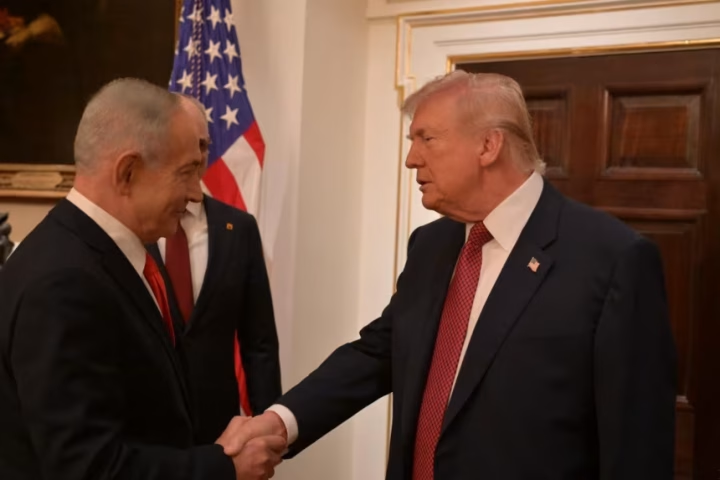
Even as Middle Eastern leaders criticized President Donald Trump’s paradigm-shifting assault on Iran after 10 days of Israeli bombardment, the American strikes are likely to be accepted—and quietly cheered—by Arab governments that have long seen Shia Iran as the main threat to regional stability.
“These countries are quietly delighted to see Iran cut down to size,” said Firas Maksad, managing director for the Middle East and North Africa at the Eurasia Group. “But the main objective is to guard against blowback targeting them.”
Statements from Turkey and Saudi Arabia stopped short of condemning the U.S. attacks on Iranian nuclear facilities. They offered only cautious expressions of concern over the expanding conflict. Qatar and the UAE didn’t even mention the United States by name. This contrasts sharply with their strong condemnations of Israel’s attacks on Iran over the past 10 days.
“It speaks volumes about how they are careful not to cross President Trump,” Maksad said. “But also about a deep desire to keep playing facilitator and mediator.”
A Cold War Comes to a Boil
For decades, Iran has built powerful proxy groups across the region. These include Hezbollah in Lebanon, the Houthis in Yemen, militias in Iraq, and the Assad regime in Syria. Their focus on threatening Israel has created chaos in their host countries.
Iran’s ambition to export its 1979 Islamic Revolution has long alarmed neighbors. Sunni-led governments especially fear this influence because they rule over sizable Shia people.
The Arab-Iranian cold war has driven Israel and Gulf states closer. Many Arab governments have set aside generations of hostility toward Israel to counter Iran’s rise. Trump’s Abraham Accords, which normalized ties between Israel and several Arab nations, grew out of this anxiety.
Since Hamas—another Iranian proxy—attacked Israel in October 2023, Israel has dismantled many Iranian-backed groups. The Assad regime fell last year. In Lebanon, Hezbollah’s defeat was quietly welcomed by many, even as politicians publicly condemned Israel.
Hezbollah on the Sidelines
So far, Hezbollah has not committed to intervene. A statement Sunday praised Iran’s “courage and resilience,” but hinted that Tehran must stand on its own.
“[Iran is] capable of confronting this aggression and delivering a bitter defeat to the American and Zionist enemy,” Hezbollah said.
Over the past year, Iran largely watched as Israel destroyed Hezbollah’s power base. Israeli forces killed many of its leaders and thousands of Lebanese civilians. That inaction has left resentment.
“They feel they paid an extremely high price in the last round of fighting,” Maksad said. “Iran was nowhere to be seen. There’s a strong feeling, even among Lebanese Shia, that Iran abandoned them.”
In Syria, Ahmad al-Sharaa, who toppled Assad, has reached out to Washington. He has also signaled openness to easing tensions with Israel.
Calculated Restraint—and Looming Risks
For now, Arab leaders mainly fear Iranian retaliation. They especially worry about attacks on U.S. bases in their countries.
Yoel Guzansky, a senior fellow at Israel’s Institute for National Security Studies, predicted Iran would respond in ways meant to save face but avoid major escalation. He compared it to the 2020 missile strikes after the U.S. killed General Qassem Soleimani.
“If something happens, they expect the U.S. to safeguard their security,” Guzansky said.
Any Iranian attack on Gulf Arab allies could pull Washington deeper into conflict. The 2019 Houthi drone strike on Saudi Aramco is a reminder of how quickly hostilities can spiral.
If the U.S. were to push for regime change in Iran, Arab leaders’ concerns could grow. Gulf states fear a chaotic collapse that might trigger unrest among their own Shia populations.
Other Reads: Jurassic World Rebirth Review: Familiar Thrills Return, Hamas Urges Global Action Against Gaza Aid Massacre