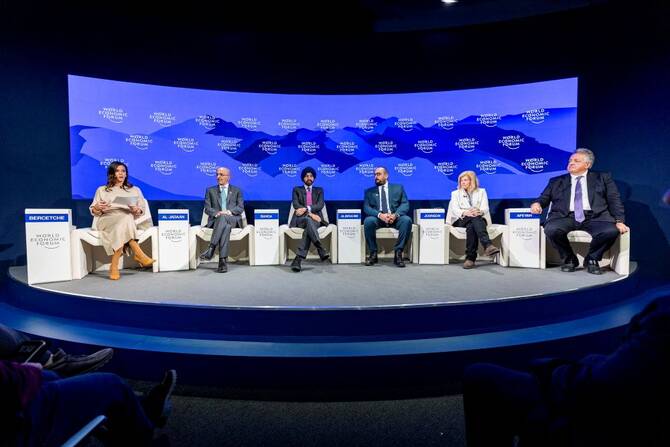
Saudi ministers argued that stability is the crucial ingredient for long-term economic growth. They made this case during a panel discussion at the World Economic Forum in Davos. In a fragmented global economy, predictability becomes a rare currency. Consequently, Minister of Economy and Planning Faisal Alibrahim stated stability cannot be bought or improvised. It must be built and accumulated patiently over time. He emphasized that Saudi Arabia treats stability as a discipline. This disciplined approach forms a competitive edge for the Kingdom.
Finance Minister Mohammed Al-Jadaan explained the private sector’s need for predictability. Businesses can price tariffs and taxes, but they struggle to price ambiguity. Therefore, Saudi policy focuses on reducing uncertainty. This allows the private sector to plan long-term alongside government-led structural reform. Both ministers highlighted Saudi Vision 2030 as the framework for this predictable, long-term planning. They outlined how the plan moves through phases of reform, execution, and impact maximization.
The Pillars of Saudi Arabia’s Economic Discipline
The ministers detailed several pillars underpinning Saudi Arabia’s strategy. First, predictable policymaking provides a clear roadmap for investors. Second, disciplined public finances ensure sustainability. Minister Al-Jadaan was explicit on this point: “You cannot compromise public finance for the sake of growth.” He described the Kingdom’s approach as “deficit by design.” This means borrowing strategically to fund growth-enhancing capital expenditure, not consumption.
Third, continuous engagement with the private sector streamlines regulation. Minister Alibrahim noted reform on paper is insufficient. It must be coupled with execution that allows businesses to develop long-term confidence. This combination creates what Alibrahim called “the right kind of stability.” In a world where geopolitical tension erodes trust, Saudi Arabia positions its stability as a valuable asset. This trust ensures commitments made today will be honored tomorrow, a rarity in current global trade.
Vision 2030: A Multi-Phase Long-Term Journey
Finance Minister Al-Jadaan framed Saudi Vision 2030 as a multi-phase journey. The initial phase focused on deep structural reforms. A subsequent execution-heavy phase implemented these changes. The Kingdom now enters a third stage focused on maximizing impact. Al-Jadaan said Saudi Arabia is in a phase of “learning, reprioritizing and staying the course.” This requires the courage to make bold decisions and persist through difficulties.
The long-term horizon is a distinct advantage. Minister Al-Jadaan contrasted this with countries constrained by short election cycles. “If you cannot take a long-term view in a turbulent world, it becomes very difficult,” he stated. He cited success stories like Singapore and South Korea, built on decades-long plans. Saudi Vision 2030 provides a similar multi-decade compass. This guides investment and policy beyond transient political or economic shocks.
International Endorsement and Future Focus
International panel participants endorsed the Saudi approach. Noubar Afeyan, CEO of Flagship Pioneering, noted Saudi Arabia is turning vulnerabilities into strengths. By leveraging technology and a strategic vision, it aims to become a net exporter of innovation. World Bank President Ajay Banga said Vision 2030 built physical and human infrastructure. This allows the Kingdom to capitalize on its demographic dividend.
Jennifer Johnson, CEO of Franklin Templeton, praised Saudi policymakers’ openness. She noted their unusual willingness to ask what they need to do better. Looking ahead, Minister Alibrahim said the next phase focuses on optimal capital deployment. Momentum must continue while costs are tightly managed. The goal is to ensure disciplined growth that enhances future resilience, not burdens it. This careful balance is the essence of the long-term reform philosophy.
Stability as a Response to Global Fragmentation
The Saudi message responds directly to rising global economic fragmentation. As trust erodes and supply chains Balkanize, predictability gains value. Minister Alibrahim argued that in this environment, stability becomes a “rare currency.” Countries that can offer it attract a premium in investment and trade. Saudi Arabia’s massive transformation requires immense capital. Its ability to present itself as a stable, long-term partner is therefore a strategic imperative.
The discipline extends to resisting short-term populist spending. Minister Al-Jadaan warned against borrowing for consumption, which burdens future generations. Instead, strategic debt funds investments that enhance future growth capacity. This fiscal conservatism, paired with ambitious vision, aims to build a durable economy. It is a calculated bet that in a volatile world, steadfastness will win.
Broader Implications for Global Investors
For global investors, the Saudi pitch is clear. The Kingdom offers a large, unified market with a coherent long-term plan. Regulatory engagement is continuous, and policy predictability is high. This reduces the risk premium often associated with emerging markets. The stability narrative is particularly aimed at attracting patient capital for mega-projects and diversification efforts.
The success of this narrative depends on consistent execution. If Saudi Arabia can maintain fiscal discipline and policy predictability through economic cycles, it will validate its claim. The Davos panel served as a powerful platform to broadcast this commitment to the world’s financial and political elite. The coming years will test whether this promised stability can withstand internal and external pressures.
Read Also: US Touts Vision for ‘New Gaza’ as Luxury Real Estate Hub